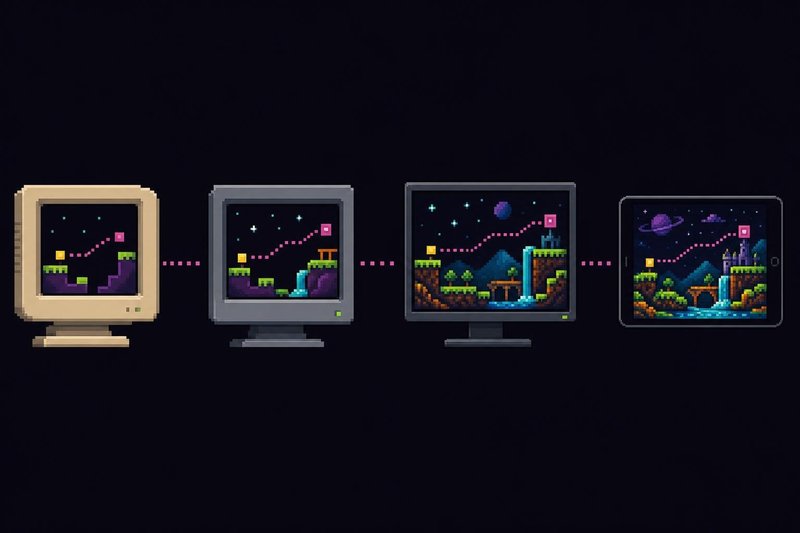
The history of free online games before plug-ins
The history of free online games starts well before the web. Text adventures and multi-user dungeons ran on university networks in the 1980s, and play-by-email games ran on bulletin boards. None of it looked like a modern game, and none of it needed more than a terminal.
The web arrived in the early 1990s, and in 1995 Sun released Java. Java applets were small programs embedded in a page, and they were the first real games inside a browser: card games, checkers, early puzzle games and the casual rooms of sites like Pogo and Yahoo! Games. Applets were slow to start and often froze the browser while loading, but they proved that people would play games on a web page.
The Shockwave games of the late 1990s
Macromedia released the Shockwave plug-in in 1995. It let projects made in Director, already the standard tool for CD-ROM games and interactive discs, play inside a browser. For a few years Shockwave games were the most polished free content on the web, and brands noticed.
That produced the advergame. Food, drink and toy companies paid for free game sites that kept their logo on screen: sports games, puzzle games, mini golf. Candystand, built around Life Savers and other Nabisco brands, was one of the best known, with sports titles like wiffle ball and bowling. Macromedia's own portal, Shockwave.com, launched in 1999 with games and animated series.
In 2001 Director 8.5 added Shockwave 3D. Real-time 3D in a browser was remarkable for the time, and Shockwave games of that era still look ambitious next to most of what followed for a decade.
The Flash years: 2000 to 2010
Flash had launched at the end of 1996 as an animation tool, but it became the default for free online games around 2000. Its files were tiny, its plug-in was nearly universal, and the editor was friendly to artists who had never written code.
Portals followed quickly. Newgrounds, founded by Tom Fulp in 1995, became the home of Flash games and cartoons. Miniclip opened in London in 2001, AddictingGames in 2002, Armor Games in 2005 and Kongregate in 2006. Each paid creators through ads, sponsorships or revenue sharing, which made Flash games a small but real business.
Adobe bought Macromedia in 2005, and in 2006 Flash Player 9 brought ActionScript 3 with a much faster engine. The best known flash games came in the following years: Desktop Tower Defense, Bloons, Line Rider, Fancy Pants Adventure, The Impossible Quiz, QWOP, Meat Boy. Social networks added another wave. FarmVille, launched on Facebook in 2009, was a Flash game played by tens of millions of people.
The turn: phones, HTML5 and the end of plug-ins
The iPhone launched in 2007 without Flash, and Apple never added it. In April 2010 Steve Jobs published "Thoughts on Flash", explaining why. At the same time HTML5 gave browsers their own canvas for drawing and their own audio, so games no longer needed a plug-in.
No change in the history of free online games came faster. Browsers pulled support away step by step. Plug-ins were switched to click-to-play, then disabled by default. Java applets went first, as browsers dropped the old plug-in system around 2015. Adobe ended the Shockwave player in April 2019 and Flash Player at the end of 2020.
After 2020: browser games and preservation
Browser games did not end. HTML5 and WebGL games now run on portals like Poki and CrazyGames, many of them made with engines such as Unity, Construct or Phaser, and they play on phones as well as computers.
The latest chapter in the history of free online games is preservation work, which kept the older games alive. BlueMaxima's Flashpoint started in 2018 and has archived well over a hundred thousand titles, including Shockwave games and Java applets. The Ruffle emulator brought Flash games back into ordinary browsers, and the Internet Archive and Newgrounds use it on their own pages. The practical side of that is covered in how to play Flash games today, the format split in Flash vs Shockwave, and the fate of the big sites in the portal guide.
Common questions
What was the first free online game?
There is no single first. Text games on university networks came in the 1980s, and Java applets in 1995 were the first games played inside a web page.
When were Shockwave games most popular?
Roughly from 1997 to the early 2000s, before Flash took over most free online games. Shockwave stayed in use for 3D titles for some years after.
Why did Flash games disappear?
Phones never supported Flash, HTML5 gave browsers the same abilities without a plug-in, and Adobe ended Flash Player in December 2020. The games themselves survive through Ruffle and Flashpoint.
Are browser games still made today?
Yes. HTML5 and WebGL games are made and played every day, on portals and on developers' own sites, and many run on phones as well.